


Tokyo is generous to gluten-free travelers who can search in Japanese, and nearly silent to everyone else. The restaurants exist, and there are more of them every year. The problem is that they are indexed in Japanese, on Japanese websites, described in words no English speaker would think to type.
This article is our search routine written out completely: the five words we type, the two sites we type them into, the small review trick we lean on, and the checking habit that keeps an out-of-date review from planning your evening. It is the routine we use to feed our own household, not a method assembled for this article.
Who is writing this
Planning a gluten-free trip to Tokyo?
See the 100+ verified spots in our Tokyo Guide →Komemaru has a mild wheat allergy, not celiac disease. We live in Tokyo, and searching for places she can eat is a normal part of our week.
The finding part of this article works the same for everyone. The deciding part does not: what counts as bookable for us is looser than what a celiac reader needs. So please treat every place this routine surfaces as a lead to verify, not a green light, and hold your own line at the verification step further down.
The five search words
The most useful thing we can hand you is vocabulary. Much of what you are looking for in Tokyo describes itself in Japanese, and some of it describes itself by ingredient rather than by diet label, so a single English search misses whole categories of places.
These are the five words we rotate, and what each one is for.
グルテンフリー (guruten furii). The Japanese katakana spelling of gluten-free. This surfaces the places that say it out loud in Japanese: restaurants and cafes that have decided gluten-free is part of what they offer, and say so to a Japanese audience.
gluten free. The plain English phrase. This surfaces places writing for international visitors, and, just as valuable, English-language reviews left by travelers who have already asked the questions you are about to ask.
glutenfree. The same phrase as one word, the way hashtags write it. We will be honest about this one: we sometimes have the impression it returns a slightly different set of results than the two-word version, and we have never managed to prove it. It costs ten seconds, so it stays in the rotation.
米粉 (komeko). Rice flour, and the word on this list nobody guesses. A great many of the places a gluten-free traveler wants describe themselves by what they bake with rather than by who can eat it. A bakery whose sign says 米粉パン (rice-flour bread) may never write グルテンフリー anywhere. yoka, the rice-flour toast cafe we wrote about in Meguro, is exactly this kind of place: a menu built around rice flour, described by its ingredient rather than by a diet label.
rice flour. The English side of the same idea, for Google Maps and for English-language posts about Japanese bakeries.
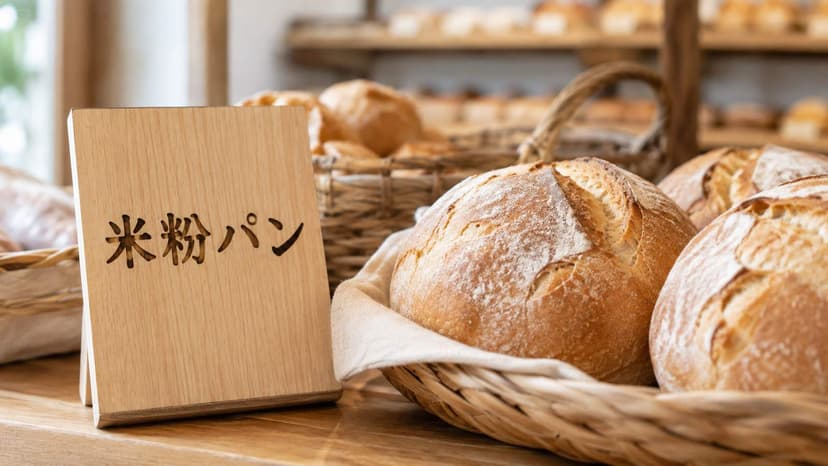
米粉パン, rice-flour bread. This is the kind of sign the word 米粉 finds for you, and it is worth knowing that the shop may never write the words gluten-free anywhere
One caution, and it matters: 米粉 finds candidates, not answers. Rice flour is an everyday ingredient in Japan, and plenty of kitchens use it alongside wheat rather than instead of it. A rice-flour sign tells you a place is worth a closer look. It does not tell you the bread is wheat-free, and it says nothing about the rest of the kitchen. The verification step below exists for exactly this reason.
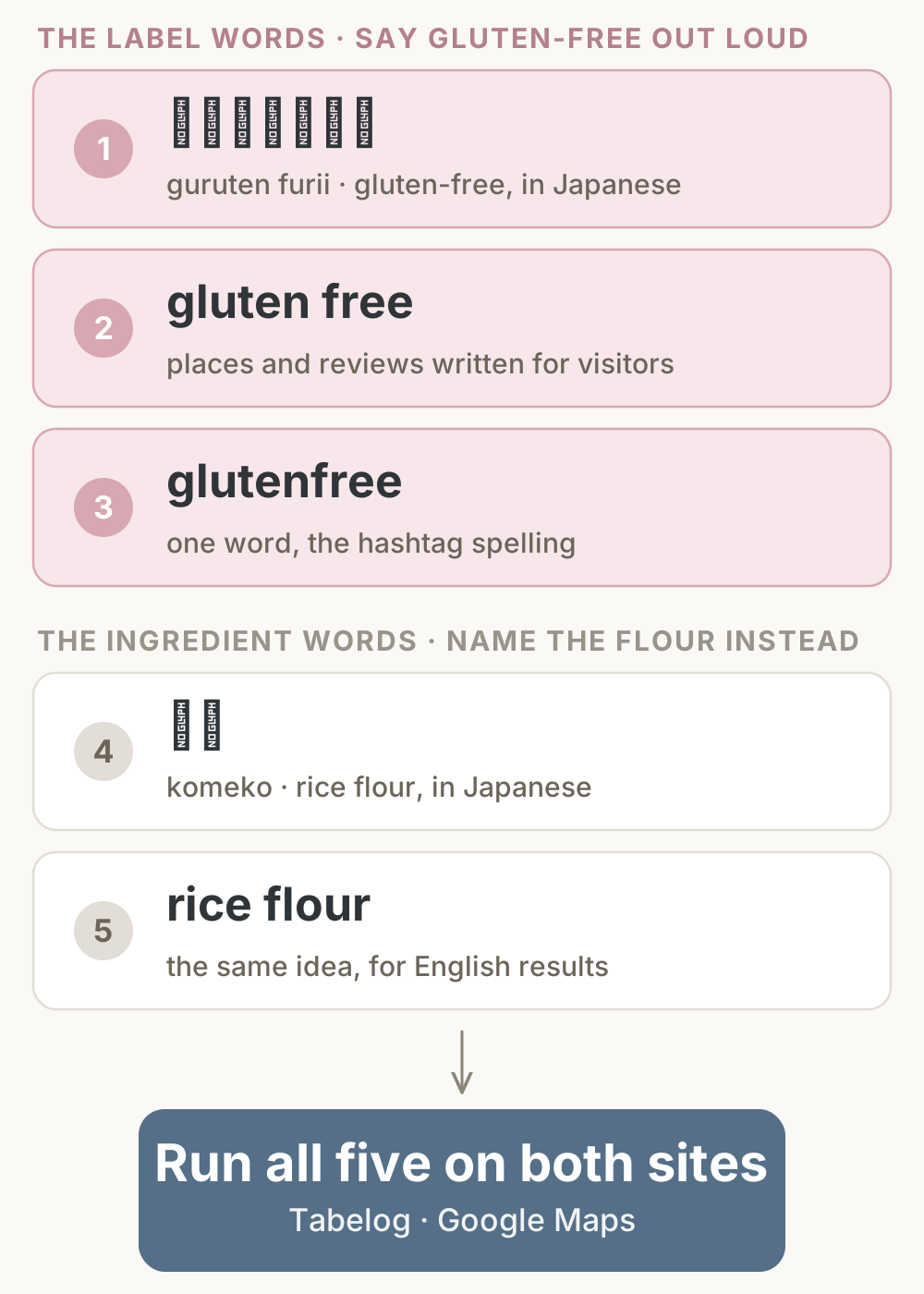
Three words find the places that say it, two find the places that bake it. We run all five on both sites
Tabelog, and the search inside the reviews
Tabelog is where Japan looks up restaurants. It describes itself as Japan's number one restaurant listing and reservation site, and in daily life here it plays roughly the role Google reviews or Yelp play elsewhere: the page you check before trying somewhere new.
We use the Japanese version, and we use it in the app rather than in a browser, for the least strategic reason imaginable: it is what we have always used. That detail matters more for you than it does for us, though, because app stores stock different apps depending on the country an account belongs to. From our Japanese account we could not download a non-Japanese version to try, so we honestly cannot tell you what one is like, and the same wall may stand between you and the Japanese app.
If the app you want is not offered in your country's store, the website works in any browser from anywhere. There is also an official English site at tabelog.com/en, which we came across while writing this article and have not used enough to compare. Everything below describes what we see in the Japanese version.
The plain search is what you would expect: an area or station name plus a keyword, and all five words from the list above take their turn in that box.
The move most visitors never find is one level deeper. Open a restaurant's page, go to its review tab (口コミ), and there is a search box that looks inside that restaurant's reviews. Type グルテンフリー into it and you learn whether any diner has ever mentioned gluten-free there, even if the restaurant itself never uses the word. A review from someone who actually ordered the thing you are hoping to order tells you things no listing can, and this box is how you find that review.
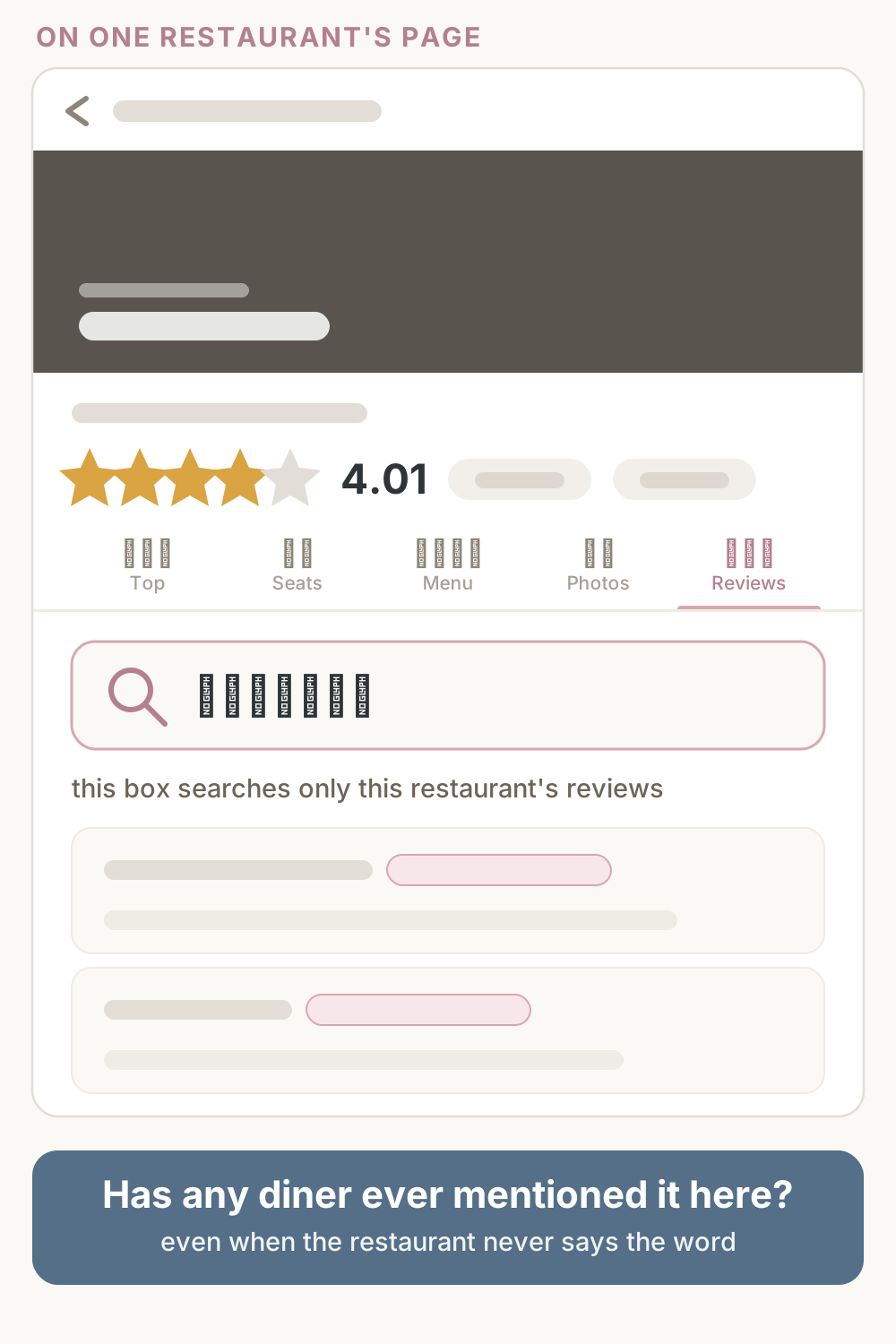
Where グルテンフリー goes. This is our own drawing rather than a screenshot: we have deliberately kept real listings and real reviews out of it, since those belong to the site and to the people who wrote them
Free: the Gluten-Free Japan Pre-Trip Checklist
What to do, and when, from six months out to your days in Tokyo. Two pages, for your phone or for print.
Get the free checklist →Google Maps, in English as well as Japanese
The other half of the routine. Google Maps takes the same five words, and its particular talent, in our experience, is surfacing places Tabelog does not, especially when we search in English. A small cafe that has little presence on Japanese review sites may still sit on the map with a handful of traveler reviews, one of which says exactly what you need to hear.
So the two sites are not a first choice and a backup. They are two nets with different holes, and we run every search on both.
The check that matters more than any search
Here is the caution this article exists to deliver: a review is a record of one visit, not a promise about the present. In Tokyo we have run into this more than once. A review says gluten-free was available, and it was true when it was written, and the restaurant has since stopped. Menus change, and nobody goes back to update old reviews when they do.
So before a place goes on our list, we look for the current menu, on the official website or the official Instagram, and we check that the menu itself says グルテンフリー対応 (gluten-free options available) or words to that effect, in the present tense. An enthusiastic review from two years ago plus a current menu that never mentions gluten-free is not a booking. It is a question to send.
And when the menu does not settle it, we write to the restaurant and ask, by email or Instagram message. In our experience small shops reply, and Instagram is frequently the faster channel, because the person reading the messages is often the person who runs the place. The wording of that message matters more than travelers expect, and we wrote a separate article on exactly what to say: the Japanese text we paste, line by line, and the lines a celiac reader must not copy from us.
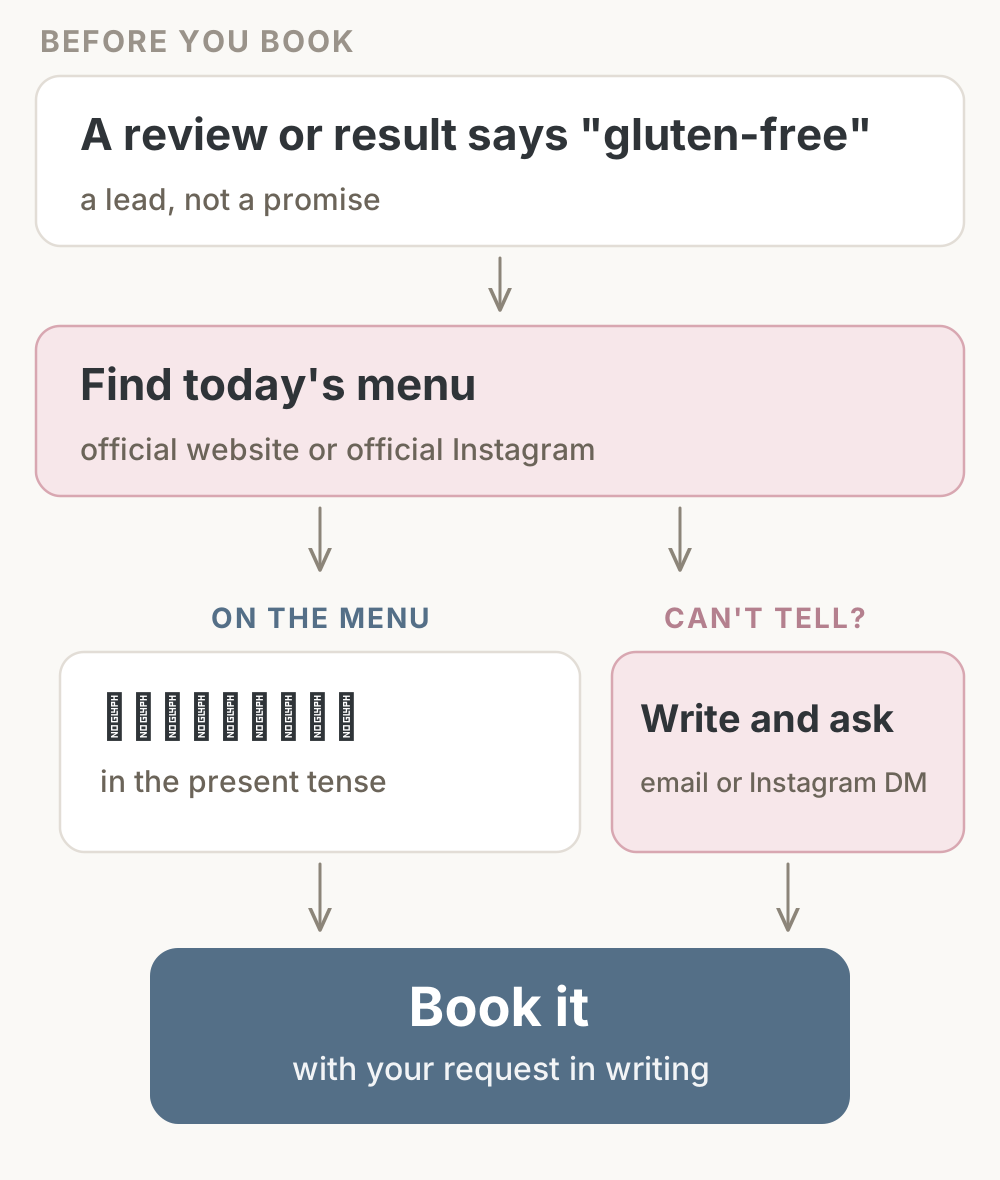
The path from a promising search result to a booking. The menu check in the middle is the part most people skip
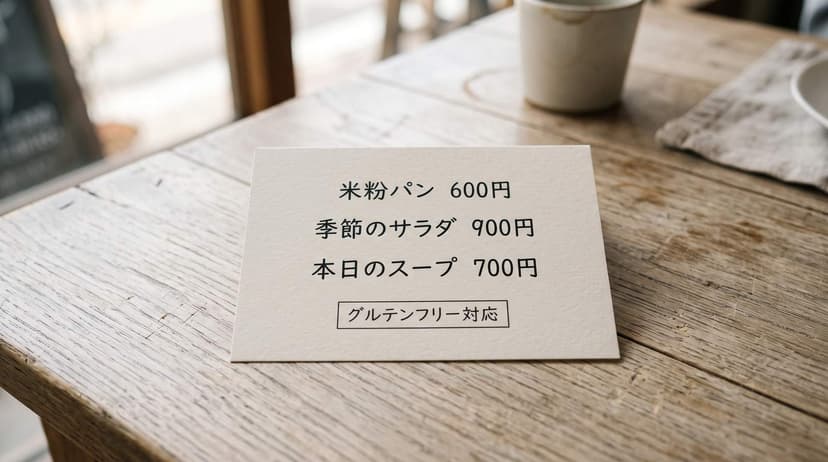
What you are looking for: グルテンフリー対応 on the menu itself, not in a reviewer's memory. An illustration rather than a real restaurant's menu, so that no shop is credited with something it may have stopped doing
When the craving is specific: Google and Instagram
Sometimes the question is not "what is near this station?" but "is there gluten-free okonomiyaki anywhere in this city?" For that, we go to plain Google search or Instagram and type it just like that: tokyo gluten free okonomiyaki.
For us this is the supporting tool rather than the main one. It answers a specific craving, while the two sites above are what build the longer list, and in our experience they surface more places overall. But Instagram earns a permanent spot in the routine for a different reason: for small Tokyo shops it is the noticeboard. Opening hours, sudden closures, sold-out announcements: the freshest version of the truth is frequently an Instagram story. Once a place is on our list, its Instagram is what we check on the morning we go.
What about the gluten-free apps?
We know Find Me Gluten Free and its relatives exist, and we barely use them. The reason is entirely unglamorous: we were Tabelog and Google Maps users for years before gluten mattered in this house, and habit won. This is not a review of those apps. If one of them already works well for you, keep it, and simply add the Japanese search words on top, because whatever tool you use, グルテンフリー and 米粉 will show you places the English words alone cannot.
The whole routine, in order
- Pick the frame. An area you will be in, or a dish you are missing.
- Run the five words on Tabelog and on Google Maps, in Japanese and in English.
- On any promising restaurant, search its reviews for グルテンフリー on its Tabelog page.
- Find the current menu on the official website or Instagram, and look for gluten-free in the present tense.
- Still unsure? Write and ask, with wording a kitchen can act on.
- Book with the request in writing, even after a yes, and check the shop's Instagram on the day you go.
If you are traveling as a party where only one of you is gluten-free, the choosing between candidates has its own logic, and we wrote about how our household does it.
An honest closing note
We should admit that we enjoy this. Chasing one katakana word through a stranger's restaurant reviews is, for us, part of the pleasure of eating in this city.
It is also, genuinely, hours of work per restaurant by the time the checking is done. If your Tokyo days are limited and you would rather spend them eating than searching, that is exactly why we made the Gluten-Free Tokyo Planning Guide: the searching and the verifying are already done, and every place in it is somewhere we have been ourselves.
This article describes how our own household, one member of which has a mild wheat allergy, searches for restaurants in Tokyo. It is a record of our experience, not medical advice or a safety guarantee. Search results are starting points: menus and policies change, so please confirm directly with the restaurant before you eat, especially if you have celiac disease. Site descriptions reflect how we use Tabelog and Google Maps as of August 2026. The street photograph, the bakery sign and the menu card in this article are AI-generated illustrations rather than photographs of a real shop, and the listing page is our own drawing.