
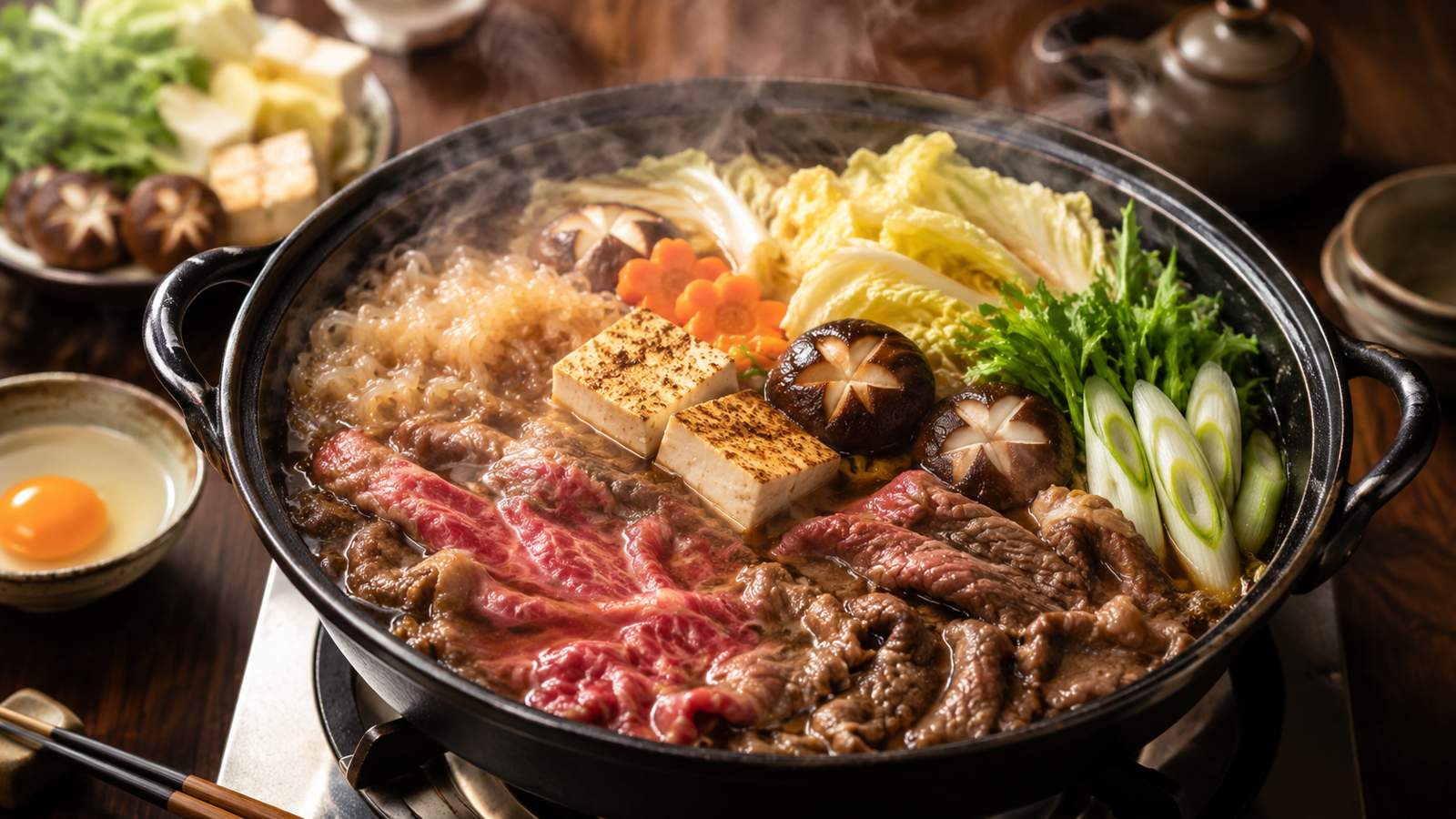
Sukiyaki as it is normally served in Japan is not gluten-free. The beef, the vegetables, the tofu and the raw egg are all fine. The problem is the liquid everything cooks in.
That is the short answer, and the rest of this article is the useful part: what actually goes into the pot, why a restaurant kitchen cannot easily change it, and the one method we would genuinely recommend to a celiac traveller who wants to eat sukiyaki in Japan.
Who is writing this
Planning a gluten-free trip to Tokyo?
See the 100+ verified spots in our Tokyo Guide →Komemaru has a mild wheat allergy, not celiac disease. In practice that means she can and does eat sukiyaki at restaurants in Japan without a problem. We are telling you that up front rather than burying it, because it changes how you should read what follows.
What we can offer you is not celiac experience. It is knowing what is actually in the pot, in Japanese, from cooking it and eating it. Every safety judgement in this article is written for a celiac reader, not for us.
What sukiyaki means in Japan
Worth knowing before you look at a menu price. Sukiyaki is a celebration dish. It appears at New Year, at family gatherings, and on the evenings that are meant to feel like an occasion, and restaurants treat it as a luxury item because the beef is usually of high quality. In our house it is the New Year meal, cooked when relatives come over.
So if you were expecting a casual weeknight dish, adjust the picture. And if the restaurant prices look high, that is what they are for.
What sukiyaki actually is
Sukiyaki is thinly sliced beef and vegetables cooked at the table in a shallow cast iron pan, then dipped into beaten raw egg before eating. It is a dish built around a sauce rather than a cooking technique, and that sauce is the whole issue.
The sauce is called warishita (割り下), and it is made from four things:
- Soy sauce (醤油)
- Mirin (みりん), a sweet rice seasoning
- Sugar (砂糖)
- Sake (酒)
Three of those four are naturally gluten-free. The first one is not. Standard Japanese soy sauce, the koikuchi type used in essentially every restaurant, is brewed from soybeans and wheat in roughly equal parts. It is not a trace amount and it is not an additive. Wheat is one of the two main raw materials.
So the sauce that every single piece of food in a sukiyaki pot is cooked in is, by design, a wheat product.
A note on the sake, since it confuses people. Japanese cooking normally uses a product called ryorishu (料理酒), literally cooking sake. It is not pleasant to drink on its own, and it is much cheaper than drinking sake, but it adds depth and rounds out the flavour, in roughly the way white wine is used in European cooking. Drinking sake works too, and a high-end restaurant may well use a good bottle, but at home it is usually an extravagance. We keep cooking sake in the cupboard as a matter of course, and if a bottle of drinking sake is sitting around and nobody is going to finish it, that goes into the pot instead.
Safety note
The most important warning on this page: tamari is not automatically gluten-free.
English-language sources repeat that tamari is "the wheat-free soy sauce". That is not reliable in Japan. Tamari describes a style of brewing, not a guarantee about ingredients, and plenty of tamari sold here contains wheat.
More broadly: most soy sauce on a Japanese supermarket shelf contains wheat. Wheat-containing soy sauce is the standard product in this country, not the exception. A bottle is safe because you read the ingredients list on the back, never because of the word on the front.
Free: the Gluten-Free Japan Pre-Trip Checklist
What to do, and when, from six months out to your days in Tokyo. Two pages, for your phone or for print.
Get the free checklist →What happens at the end of the meal
Many sukiyaki restaurants finish with a shime (シメ), a closing course cooked in the leftover sauce. The two usual options are udon noodles, which are wheat, or rice.
For a shared table this matters even if you decline the udon yourself. Once wheat noodles have gone into the pot, that pot is finished as far as a celiac diner is concerned, and the shime typically arrives while people are still eating.
Fu, the ingredient made of gluten itself
Fu (麩) is a traditional Japanese ingredient made by washing the starch out of wheat flour dough until only the gluten is left, then drying what remains. It is, quite literally, wheat gluten in solid form. Dried fu looks like small pieces of pale sponge or light bread, and in a pot it swells up and soaks in the sauce.
We want to be accurate about how often you will actually meet it. In Tokyo, fu is not a normal part of restaurant sukiyaki, and we have not been served it here. It belongs to some regional versions and to home cooking, and it turns up in other hot pot dishes more readily than in a Tokyo sukiyaki pan.
It is on this page anyway for two reasons. It is easy to misread as bread or as a dumpling, and its English name gives away nothing. And Komemaru avoids fu entirely despite a mild allergy, which tells you how straightforwardly wheat it is.
What in a sukiyaki pot is naturally gluten-free
It is worth being clear about this, because the answer is "almost everything except the seasoning":
- Beef and the beef tallow used to grease the pan
- Vegetables, including hakusai (napa cabbage), negi, shungiku and mizuna
- Mushrooms, such as shiitake, shimeji and enoki
- Tofu and yaki-dofu (lightly grilled tofu)
- Shirataki, the translucent noodles, which are made from konjac yam rather than any grain
- The raw egg used for dipping
None of these carry gluten on their own. That is genuinely the frustrating part of sukiyaki: it is a naturally gluten-free set of ingredients cooked in a sauce that is not.
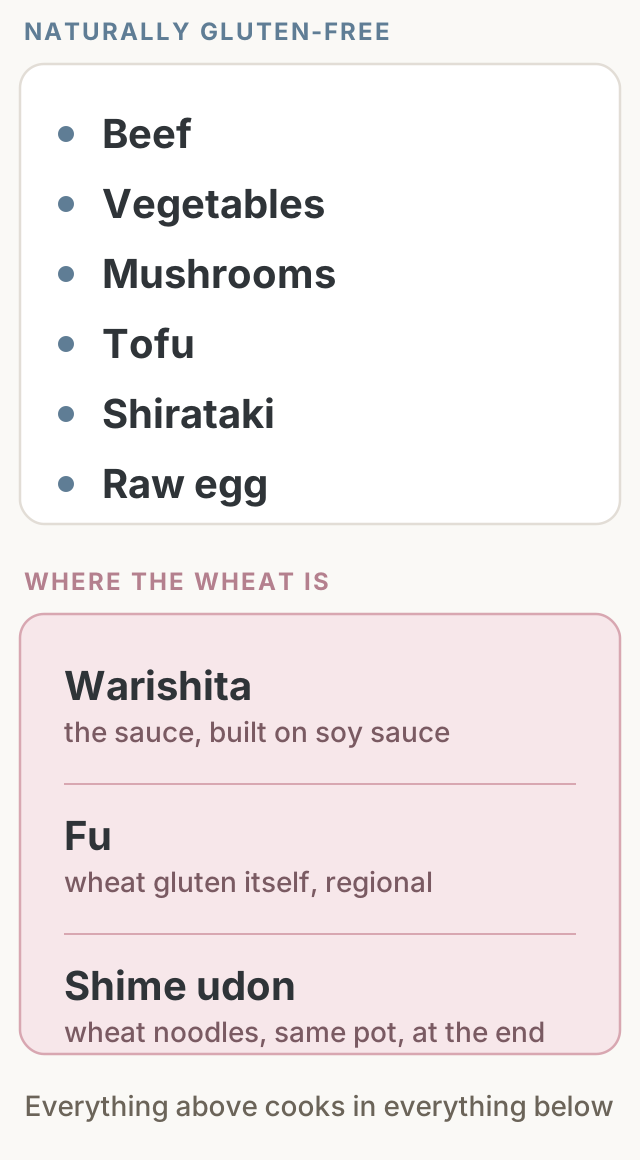
Every ingredient in the top group is fine on its own. All of them cook in the bottom group
Why a restaurant cannot simply swap the sauce
A reasonable question at this point is why a kitchen cannot just use gluten-free soy sauce instead.
The honest answer is that warishita is usually not made per table. It is mixed in advance, in quantity, for the whole service, in the same way stock is simmered in the morning before the doors open. By the time you sit down, the sauce for the evening exists. A request to change it is not a request to season one dish differently, it is a request to make a separate batch of a core recipe for one guest.
Kansai-style sukiyaki works a little differently. Rather than pouring in pre-mixed warishita, the cook sears the meat and then seasons it at the table with sugar and soy sauce directly. In principle that is a more adaptable format, because the seasoning happens in front of you. We have not tested this ourselves, and the shared pot would still be an issue for a celiac diner, so we would not want to send you into a restaurant expecting it to work.
There is also the matter of the pot itself. Sukiyaki is a shared pan by definition. Even in a hypothetical restaurant willing to mix a separate gluten-free sauce, a celiac diner eating from the same pan as a table of other people is a different question again.
Good to know
If you plan to bring your own gluten-free soy sauce to a restaurant, ask before you use it.
Some restaurants in Japan do not permit outside condiments at the table, and a few state this explicitly. This is not unfriendliness, it is a food safety rule on their side. Ask the staff first, every time.
What we actually do
Two honest accounts, one for restaurants and one for home.
At a restaurant, we eat regular sukiyaki. Komemaru's wheat allergy is mild, and ordinary sukiyaki does not cause her problems, so we have never needed to negotiate with a sukiyaki restaurant. That is a real answer, and it is also the reason we cannot tell you how a Tokyo sukiyaki restaurant responds to a strict gluten-free request. We have not made one.
We can tell you that as of August 2026, we have not found a restaurant in Tokyo serving gluten-free sukiyaki, and we have looked. That is not the same as saying none exists. A restaurant may open, or an existing restaurant may turn out to accommodate the request, and we will update this page when either happens. If you find one, please tell us and we will go.
At home, we make it gluten-free. This is the part we can speak about properly, because we have cooked it many times. We build our own warishita using gluten-free soy sauce in place of regular soy sauce, and the result tastes like sukiyaki rather than like a substitute.
※ Finding gluten-free soy sauce in Japan, and telling it apart from the wheat-containing bottles beside it on the shelf, deserves its own article. We are planning one. Until then, please treat the ingredients list on the back of the bottle as the only thing that counts.
Our gluten-free warishita
For two people, as a starting point:
- Gluten-free soy sauce, 100ml
- Mirin, 100ml
- Cooking sake, 100ml
- Sugar, 2 to 3 tablespoons as the standard amount
- Water, 100ml, adjusted as the pot cooks down
Those proportions are the standard ones, and a sauce built to them will not go wrong.
Two things we do differently, from cooking it often:
We use much less sugar than the standard amount. The textbook quantity is sweeter than we like. We start well below it and add a little at a time until it tastes right, rather than committing at the beginning.
We make a small batch first and top it up. Mixing a large quantity and then discovering the balance is off is a miserable way to start dinner. Make the minimum, taste it in the pot, and add more as the level drops. Once the sauce is in the pan, the cooking is only heat, so anyone can reproduce the same result without any experience of Japanese cooking.
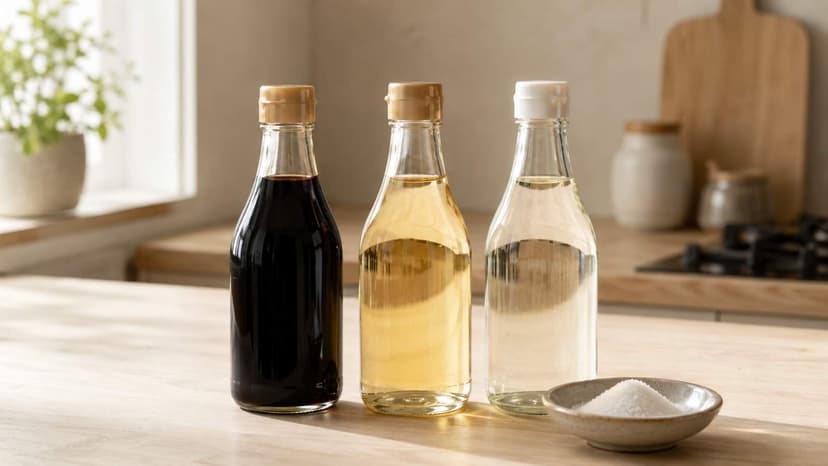
The three bottles that decide whether sukiyaki is safe. Everything else in the pot already is
The reliable way to eat sukiyaki in Japan: cook it yourself
This is the part we would actually recommend to a celiac traveller, and it is easier than it sounds.
Book accommodation with a kitchen. A rental apartment, or one of the hotel types that includes a kitchenette, turns the entire problem into a shopping trip. Sukiyaki needs no technique and no special equipment beyond a pan, every ingredient is in an ordinary supermarket, and one bottle of gluten-free soy sauce removes the only thing that made the dish unsafe.
Check the pot before you arrive. This is the one item you cannot solve at the supermarket on the night, and rentals vary. Three options: ask the accommodation in advance whether a pot is available, buy an inexpensive one after you land, or bring one. A wide, shallow pan is traditional, but any wide pan will cook it.
What we would put in the basket
- Hakusai (napa cabbage)
- Shimeji and enoki mushrooms
- Mizuna and shungiku (chrysanthemum greens)
- Tofu
- Beef
On the beef, three things matter. Buy better than the cheapest, because in this dish the beef is the meal. Look for meat labelled すき焼き用 (sukiyaki-yo), meaning cut for sukiyaki, which is sliced very thin. Thick cuts do not cook properly in a shallow simmering pan, so the label is doing real work for you. And buy two kinds, one well-marbled and one leaner such as loin, because an entire meal of rich, fatty slices gets tiring faster than you expect.
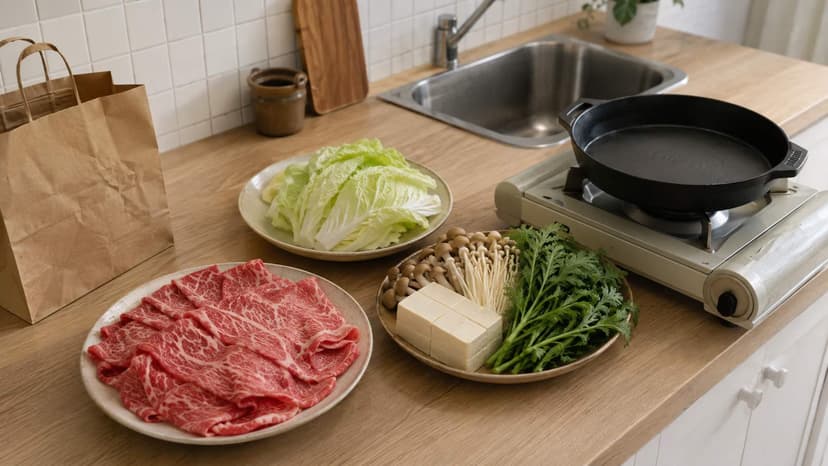
One shopping trip, and the dish that no restaurant would serve you becomes dinner
For the shime, use rice rather than udon. Japanese supermarkets and convenience stores sell pouches of pre-cooked rice that only need a microwave, and if your accommodation has one, that is the easiest finish there is. Tip the rice into what is left of the sauce and you have zosui, a savoury rice porridge.
Zosui, briefly: add the rice to the remaining broth, top up with a little water if the sauce has reduced too far, and simmer for a minute or two. Beat an egg, pour it over the surface, and stir gently once. Take it off the heat while it is still soft.
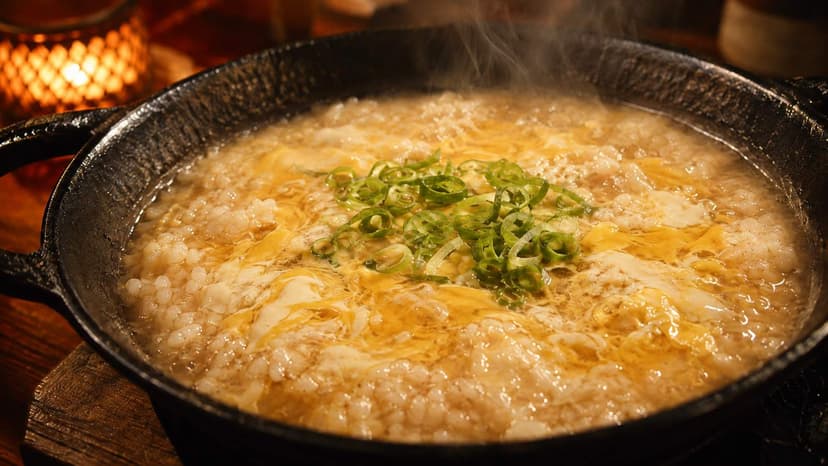
The end of the meal, cooked in what is left of the sauce
If you would rather have noodles, some Japanese supermarkets stock dried gluten-free udon. It is not everywhere, but it exists. Boil it in a separate pot of water first, then add the cooked noodles to the sukiyaki pan. Dried noodles put straight into the sukiyaki sauce will not cook properly, so this needs two pans rather than one.
The short version
Sukiyaki is a gluten-free set of ingredients cooked in a sauce that is not. The sauce is built on soy sauce, most soy sauce in Japan contains wheat, and the closing udon puts wheat into the pot even if you never ordered it. In a restaurant, as things stand in Tokyo, it is not a dish we can point a celiac traveller towards.
In a rental with a kitchen, it is one bottle away from being a very good evening. Of everything in Japanese cooking that gets taken off the table by a gluten-free diagnosis, sukiyaki is the one we would tell you to take back.
For the places in Tokyo we have visited and checked ourselves, see the Gluten-Free Tokyo Planning Guide.
This article describes what goes into sukiyaki in Japan and how our own household cooks it, in a house where one of us has a mild wheat allergy rather than celiac disease. It is a record of our experience and our reading of ingredients, not medical advice or a safety guarantee. Recipes, products and restaurant practices vary, so always read the label and confirm directly with the restaurant. Restaurant information is current as of August 2026. The images in this article are illustrations of typical Japanese ingredients and dishes, rather than photographs of a particular restaurant or of our own kitchen.