

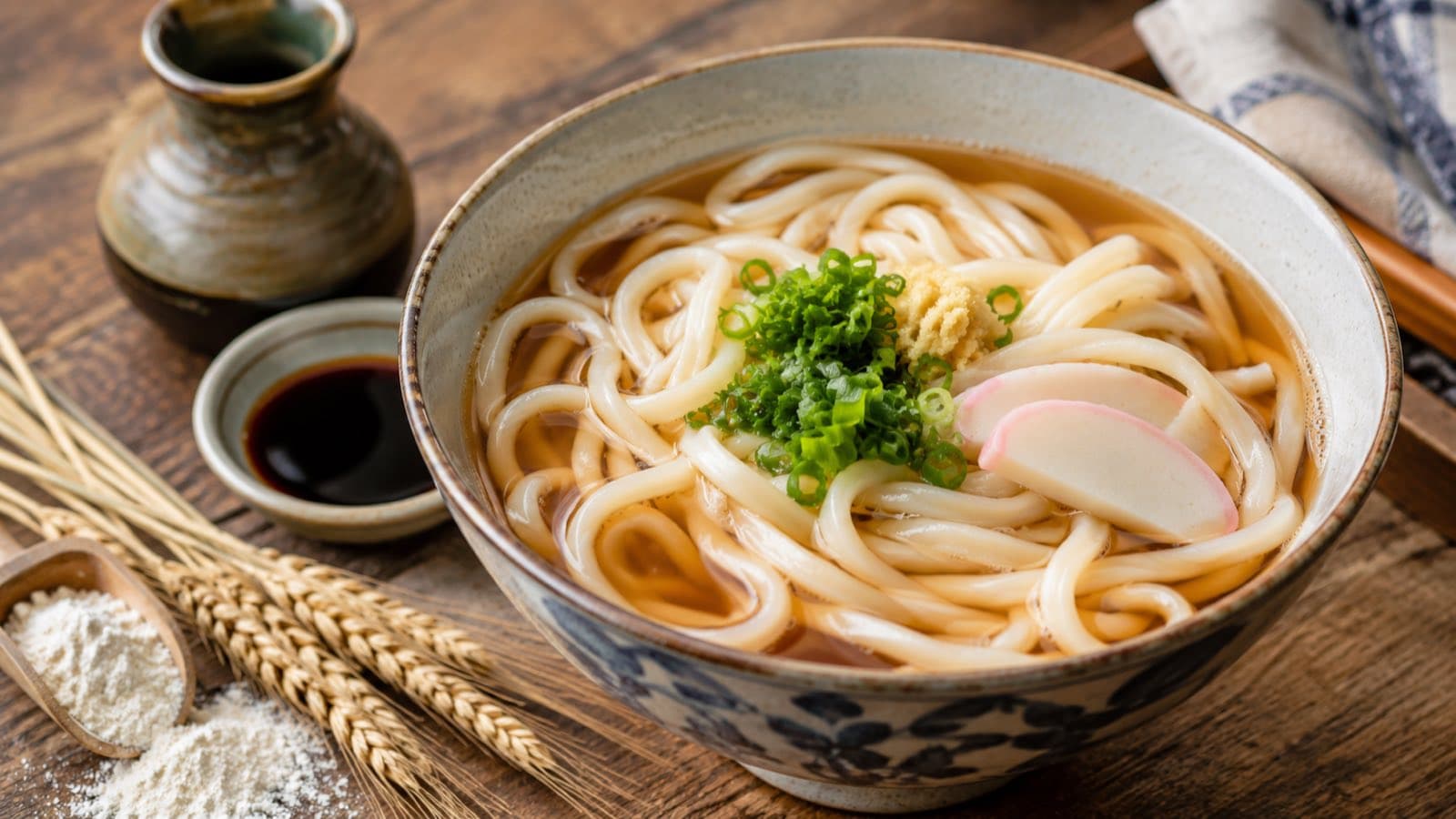
Udon is wheat flour, water and salt. It is not gluten-free, and there is no version of it that is.
That part takes one sentence, so this page is about everything around the noodle: the broth, which is a second and less obvious source of wheat, the substitution most travellers reach for and should not, and the two that actually work.
Who is writing this
Planning a gluten-free trip to Tokyo?
See the 100+ verified spots in our Tokyo Guide →Komemaru has a mild wheat allergy, not celiac disease. She does not eat udon: the noodle is wheat and nothing else, so it is a dish we cook around at home rather than order out. We would rather say that at the top than have you discover it halfway down.
What we can offer is not celiac experience. It is what is in the bowl, in Japanese, from reading the labels and cooking around it here. Every safety judgement on this page is written for a celiac reader, not for us.
What udon is, and why the regional names do not help
Udon is a thick wheat noodle, usually served in a hot dashi broth, sometimes chilled with a dipping sauce in summer. It is comfort food, it is cheap, and it is everywhere. A standing-room bowl at a station shop costs a few hundred yen and is usually in front of you in about a minute.
You will see regional names on menus, and it is worth knowing that none of them changes the answer:
- Sanuki udon (讃岐うどん) from Kagawa: thick, square-edged, famously firm
- Inaniwa udon (稲庭うどん) from Akita: thin, smooth, hand-pulled
- Ise udon (伊勢うどん) from Mie: soft, thick, served with a dark sauce rather than broth
- Kishimen (きしめん) from Nagoya: flat and wide
These differ in width, texture and technique. Every one of them is wheat flour. When a Japanese menu tells you which region a noodle comes from, it is telling you about chew, not about grain.
The broth is the second source
This is the part that catches people who have already accepted the noodle is out.
Udon broth is dashi seasoned with soy sauce and mirin. Dashi itself, made from kombu seaweed and dried bonito, is generally fine. The soy sauce is not, because standard Japanese soy sauce is brewed from soybeans and wheat in roughly equal parts.
Shops generally mix their own broth. At home it is either a bottled concentrate called mentsuyu (めんつゆ), one of the most-used products in a Japanese kitchen, or the same thing seasoned from scratch. None of that changes the answer, because whichever route it takes, the soy sauce at the base of it is ordinary soy sauce. Almost every bottle on a Japanese shelf is brewed with wheat, and a kitchen with no reason to avoid wheat has no reason to seek out the exception. Made from scratch or poured from a bottle, the broth ends up containing wheat either way.
A pale broth is not a wheat-free broth. Kansai-style udon broth looks almost clear compared to the dark Kanto version, and people reasonably assume the light colour means no soy sauce. It means a different soy sauce. Usukuchi (薄口), the lighter-coloured type, is if anything slightly saltier than the dark kind. The colour is the only thing that changed.
So the broth is a problem in every serving style:
- Kake udon (かけうどん), noodles in hot broth
- Bukkake udon (ぶっかけうどん), chilled noodles with concentrated sauce poured over
- Zaru udon (ざるうどん), chilled noodles with a dipping cup, which is mentsuyu
- Kamaage udon (釜揚げうどん), noodles served in their cooking water with a dipping sauce, which is also mentsuyu
Safety note
Do not switch to the soba counter. This is the substitution we most want to warn you off.
Buckwheat is naturally gluten-free, so soba reads like the obvious answer, and some English-language sources present it that way. In Japan it does not work like that.
Most soba sold here is a blend of buckwheat and wheat flour, with wheat as the binder that holds the noodle together. The exception is juwari soba (十割そば), which is one hundred percent buckwheat with no wheat flour at all. Some soba shops carry it and a few specialise in it, but it is not what you are handed by default.
Even a juwari noodle usually arrives with wheat beside it, because the broth or the dipping sauce is made with ordinary soy sauce. A wheat-free noodle does not make the dish wheat-free.
And in nearly every noodle shop, udon and soba are boiled in the same water. Standing noodle shops in stations serve both from one counter and one pot. Even a genuine juwari noodle cooked in that pot has been cooked in wheat.
Soba deserves its own page and will get one. For now: moving from the udon side of the menu to the soba side is not a gluten-free decision.
Free: the Gluten-Free Japan Pre-Trip Checklist
What to do, and when, from six months out to your days in Tokyo. Two pages, for your phone or for print.
Get the free checklist →Where udon appears when you did not order it
Udon has a habit of arriving as part of something else.
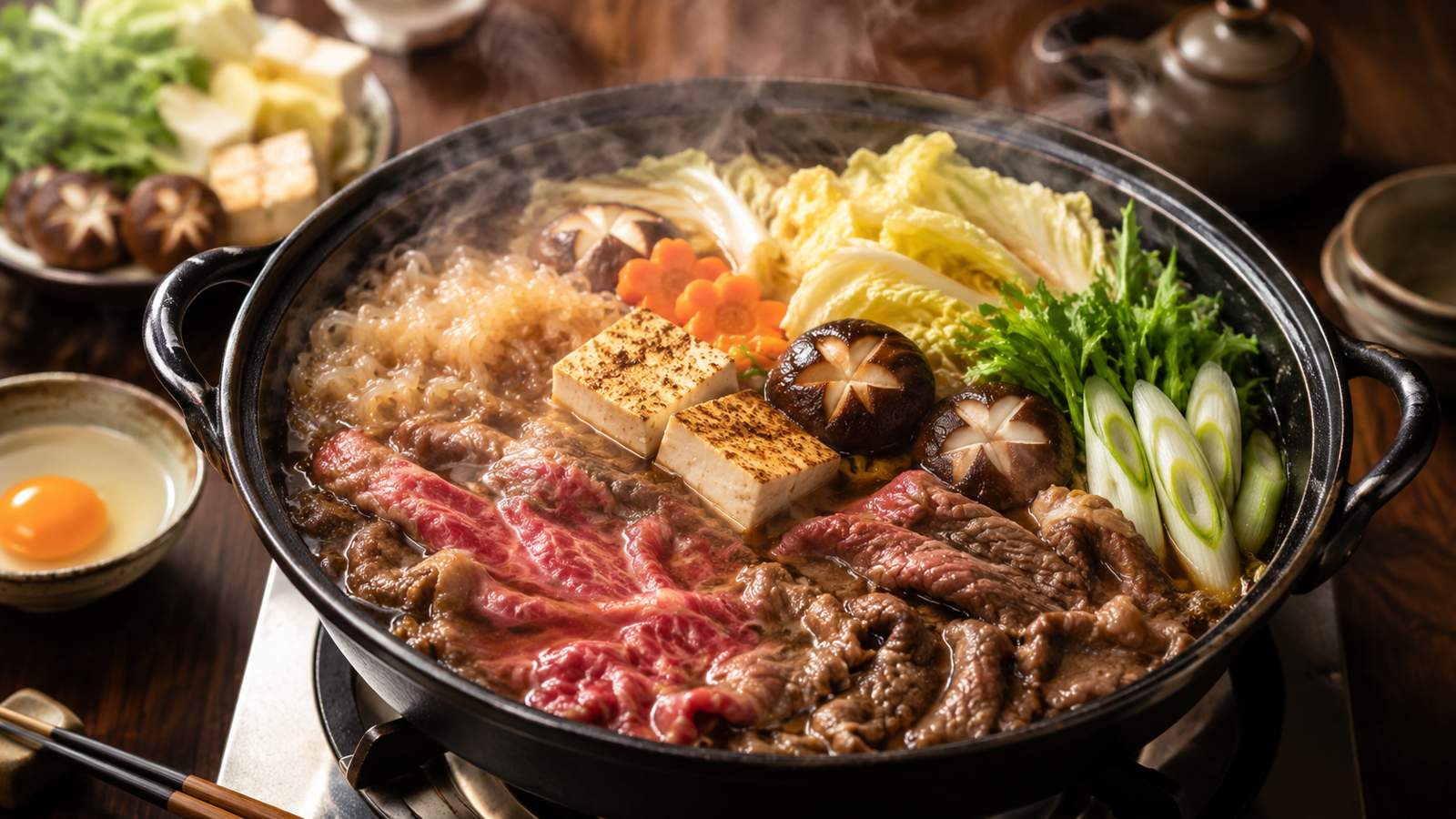
At the end of a hot pot. Many nabe restaurants and most sukiyaki restaurants finish the meal with a shime (シメ), a closing course cooked in the remaining broth, and udon is one of the two standard options. It comes with the course. For a shared pot this matters even if you decline your own portion, because once wheat noodles have gone into the pot, the pot is finished. We go into this in more detail in our page on sukiyaki.
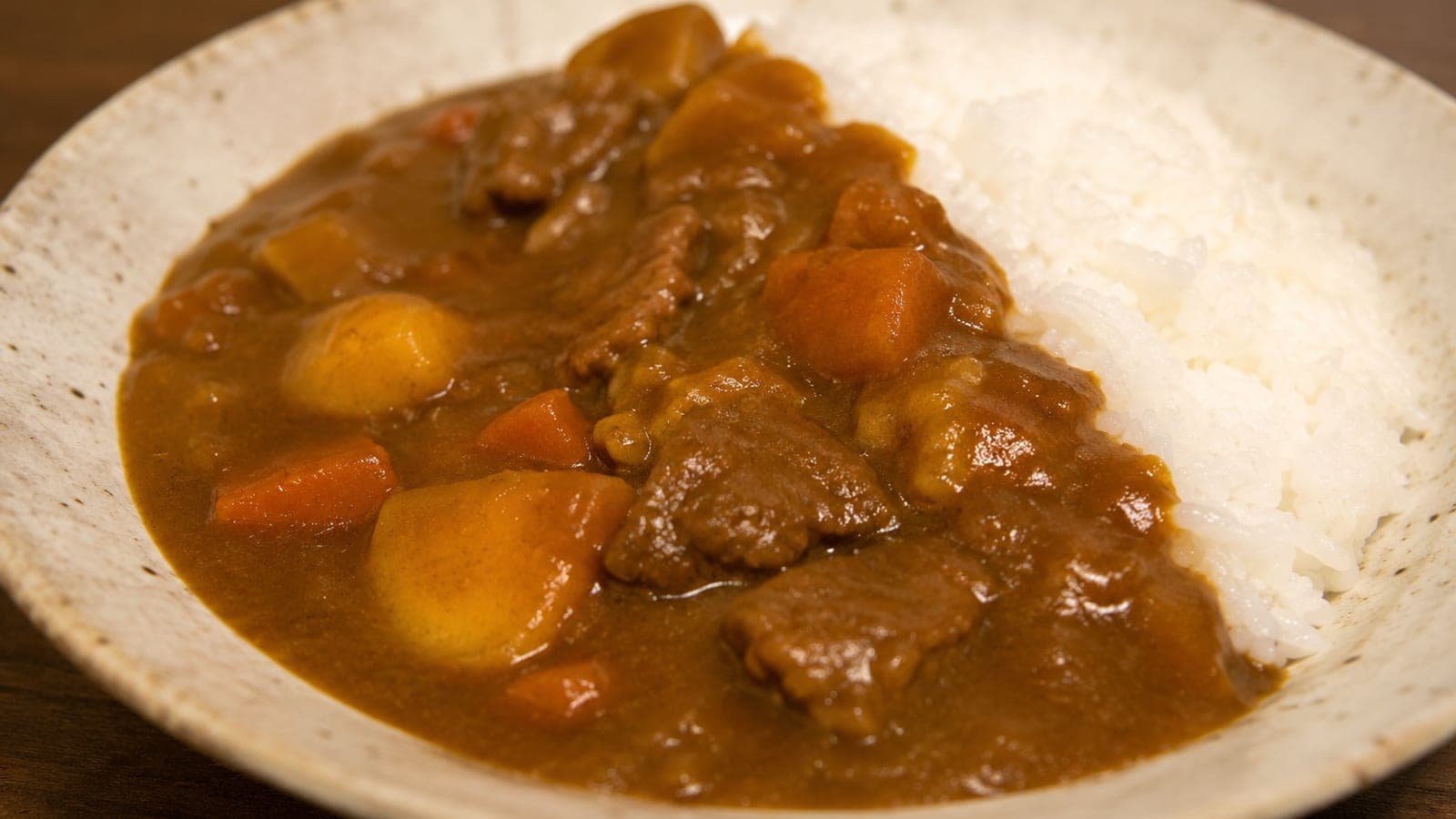
Curry udon (カレーうどん) is wheat twice over, since Japanese curry roux is built on wheat flour as well.
Yaki udon (焼きうどん) is the same noodle stir-fried, usually with soy sauce or a sauce that is itself wheat based.
Set lunches. A teishoku with a small bowl of noodles alongside the main dish is a common format, and the noodles are often not mentioned in the name of the set.
What is actually safe at an udon shop
We wish this list were longer.
The rice is fine. Plain white rice, and onigiri rice balls if the filling is plain. But most of the counter is against you: tempura toppings are wheat batter, tenkasu (天かす), the crunchy batter bits, are scattered on for free and often already in the bowl, inari pouches are simmered in soy sauce, and the kitsune fried tofu on top is simmered in the same.
A standing udon shop is, in practice, one of the harder rooms in Japan to eat safely in. We would not send you into one looking for something to order.
The two substitutions that work
Gluten-free dried udon exists as a product. Noodles made from rice flour, sold specifically as a gluten-free udon, turn up in some Japanese supermarkets, and more reliably in natural food shops (自然食品店). They cook like dried noodles rather than fresh ones and they are a genuine substitute at home. As with anything here, the ingredients list on the back of the packet is what settles it, not the word on the front.
Rice noodles are the wider path. Vietnamese pho noodles and other rice noodles are stocked in ordinary supermarkets and in the imported-food shops you will find in most Tokyo shopping centres. They are not udon and they will not pretend to be, but in a hot dashi broth they do the same job at dinner.
Shirataki (しらたき), the translucent noodles made from konjac yam, are worth knowing about too. They are not a wheat product at all and they are in every supermarket, chilled, near the tofu. The texture is nothing like udon, though: springy and slippery rather than soft and chewy. Treat them as a different noodle rather than a stand-in for this one.
Making it at home
An udon broth without wheat is a straightforward thing to build, and it is the same base you will use for a dozen other dishes.
Start with dashi, then season it with gluten-free soy sauce and mirin. Rough proportions to begin with: eight parts dashi to one part soy sauce to one part mirin for a hot broth, adjusted to taste. Bring the mirin briefly to a simmer to cook off the alcohol before it goes in.
One thing to check on the dashi. Kombu and dried bonito flakes are fine on their own. The instant granules sold as dashi no moto (だしの素), which is what most households actually use, are a blended product and can contain wheat-derived ingredients. Dashi packs, the teabag-style sachets, vary in the same way. Read the packet rather than assuming that dashi as a category is safe.
Once you have that broth, rice noodles or gluten-free udon go straight into it, and you have the bowl.
What to ask, and where
At an udon shop there is not much to ask, because the noodle settles it before the conversation starts. The questions below are for the two places they actually help: a noodle shop that also sells soba, and a hot pot restaurant where udon may arrive at the end without being ordered.
そばのつなぎに小麦粉は使われていますか?
そばとうどんは同じお湯で茹でていますか?
シメのうどんは入れないでいただけますか?
What each line says:
- Is wheat flour used as the binder in the soba?
- Are the soba and the udon boiled in the same water?
- Could you leave out the udon at the end of the meal?
Read aloud, roughly:
Soba no tsunagi ni komugiko wa tsukawarete imasu ka?
Soba to udon wa onaji oyu de yudete imasu ka?
Shime no udon wa irenai de itadakemasu ka?
The third one is worth having ready before a hot pot meal rather than during it. The closing course tends to arrive while everyone is still eating, and once wheat noodles are in a shared pot, the pot is done.
The short version
Udon is wheat in the noodle, and the broth is wheat again through soy sauce. The pale Kansai broth is no different from the dark one in that respect. The soba counter next door is not a way out, because most soba is cut with wheat flour and boiled in shared water.
What does work is cooking it, which is easy: a dashi broth with gluten-free soy sauce, and rice noodles in place of the wheat. Of the dishes on this site, udon is one of the simplest to rebuild at home and one of the least promising to chase in a restaurant.
For the places in Tokyo we have visited and checked ourselves, see the Gluten-Free Tokyo Planning Guide.
This article describes what goes into udon in Japan and how our own household cooks around it, in a house where one of us has a mild wheat allergy rather than celiac disease. It is a record of our experience and our reading of ingredients, not medical advice or a safety guarantee. Recipes and products vary, so always read the label and confirm directly with the restaurant. Information is current as of August 2026.